The Feynman point: six 9s in pi at position 762
The Feynman point is a run of six 9s in a row that starts at position 762 of pi. It looks like a pattern. Here is how rare it is, and what the longest runs of a single digit are in the first 10 billion digits of pi.
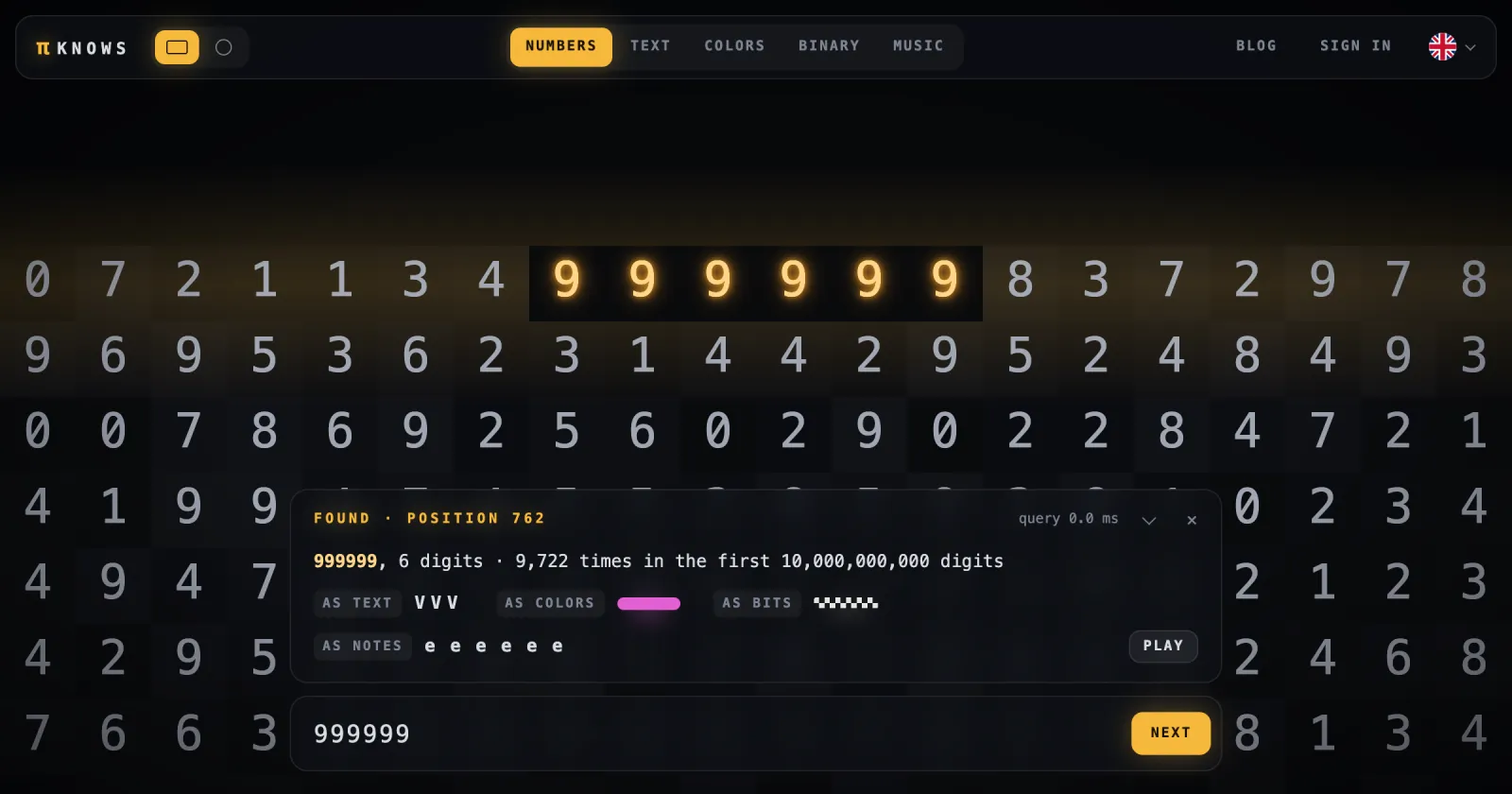
Where the Feynman point is
Counting from the first digit after the decimal point, the digits from position 759 read 134999999837. The six 9s fill positions 762 to 767. This is also where pi first shows three, four, five and six 9s in a row. Before it, pi has only three runs of three: 111 at position 153, 555 at 177 and 000 at 601.
Why it is called the Feynman point
The name comes from a story about the physicist Richard Feynman. He is said to have wanted to learn pi by heart up to this point, so he could recite it, finish on the six 9s and add "and so on", as if pi were nines forever. Nobody knows when, or even whether, he said it, as Wikipedia notes.
How rare is the Feynman point?
Rare, but not impossible. If the digits of pi were random digits, six 9s in a row would first turn up, on average, after about 1.1 million digits. A start by position 762 would happen about once in 1,500 tries. Six of any one digit that early, about once in 150.
The other nine digits are on time. Each first appears six times in a row between position 222,299 and 1,699,927, well within the usual spread around the 1.1 million chance predicts:
| Six in a row | First position |
|---|---|
| 000000 | 1,699,927 |
| 111111 | 255,945 |
| 222222 | 963,024 |
| 333333 | 710,100 |
| 444444 | 828,499 |
| 555555 | 244,453 |
| 666666 | 252,499 |
| 777777 | 399,579 |
| 888888 | 222,299 |
| 999999 | 762 |
The longest runs of one digit in pi
Each digit added to a run makes it about 10 times rarer. Here is where pi first repeats a digit 2 to 10 times in a row, beside where chance would put it on average:
| In a row | Digits | First position | Chance, on average |
|---|---|---|---|
| 2 | 33 | 24 | 10 |
| 3 | 111 | 153 | 110 |
| 4 | 9999 | 762 | 1,100 |
| 5 | 99999 | 762 | 11,000 |
| 6 | 999999 | 762 | 110,000 |
| 7 | 3333333 | 710,100 | 1.1 million |
| 8 | 44444444 | 22,931,745 | 11 million |
| 9 | 777777777 | 24,658,601 | 110 million |
| 10 | 6666666666 | 386,980,412 | 1.1 billion |
Only the Feynman point stands out. Seven 9s in a row come much later, first at position 1,722,776.
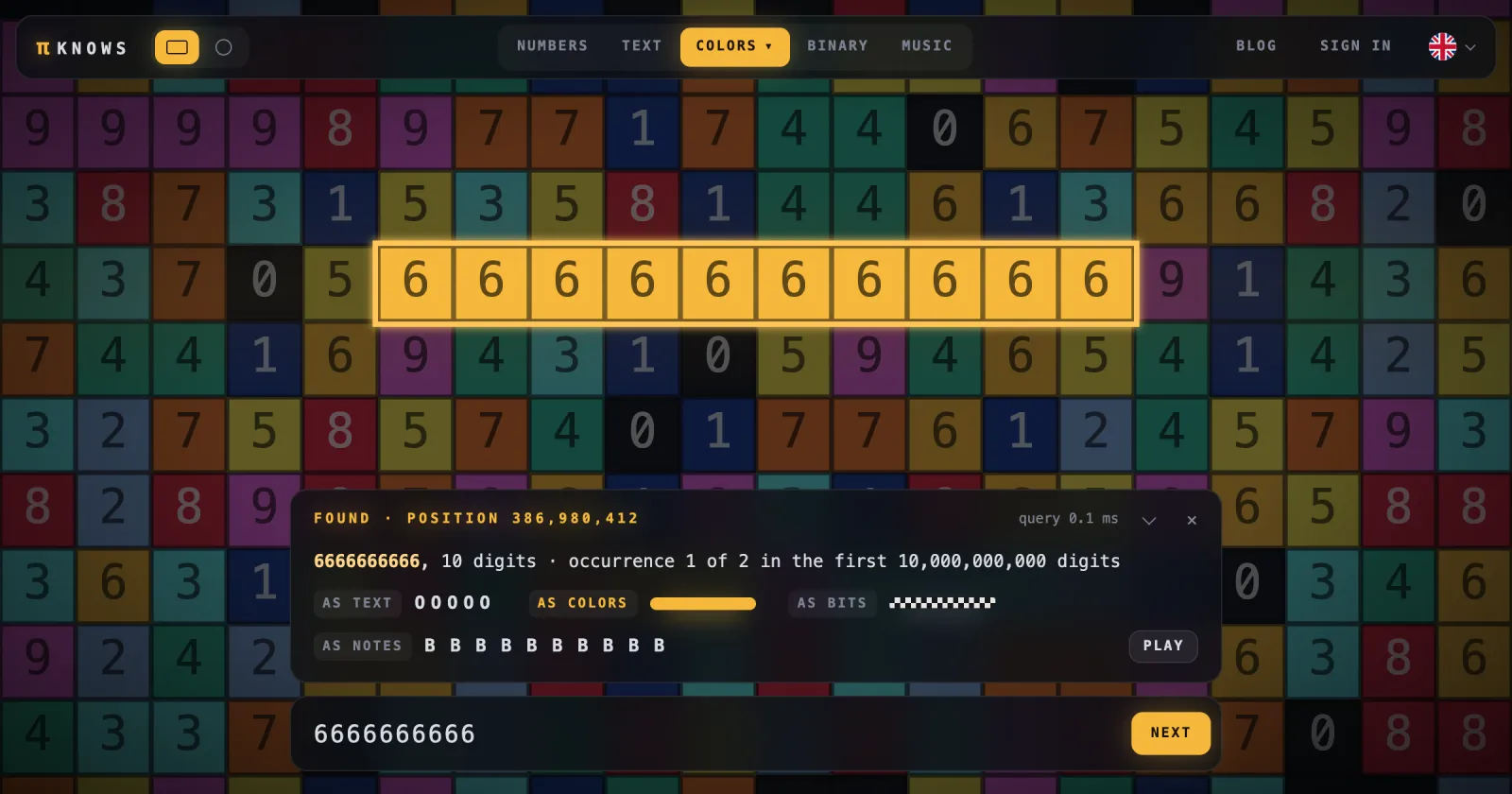
Ten in a row: the record in 10 billion digits
The first 10,000,000,000 digits hold eight runs of ten identical digits, and none of eleven:
| Run | Position |
|---|---|
| 6666666666 | 386,980,412 |
| 8888888888 | 3,040,319,543 |
| 1111111111 | 3,961,184,001 |
| 3333333333 | 4,663,739,959 |
| 5555555555 | 7,644,991,298 |
| 3333333333 | 8,313,901,578 |
| 0000000000 | 8,324,296,435 |
| 6666666666 | 9,074,607,642 |
Chance predicts about eight runs of ten, and about one of eleven or more. Finding none of eleven happens about four times in ten, so this too is ordinary. There is no run of ten 2s, 4s, 7s or 9s yet: the longest run of 9s is nine digits, first at position 564,665,206.
Is the Feynman point a sign of a pattern in pi?
No. With ten digits and many runs to look at, one run that comes early is the kind of thing chance throws up now and then, and every other first run in the first 10 billion digits falls within the usual spread of chance. For a pattern in pi to mean something, it would have to be much longer, or much earlier, than this: see is there a message in pi. Search for a run of your own:
Frequently asked questions
What is the Feynman point?
Six 9s in a row in the digits of pi, starting at position 762, counting from the first digit after the decimal point.
Why is it called the Feynman point?
After a story that the physicist Richard Feynman wanted to recite pi up to the six 9s and then say "and so on", as if the 9s went on forever. Nobody knows whether he said it.
How rare is the Feynman point?
If the digits of pi were random, six 9s in a row would first appear after about 1.1 million digits on average. Starting as early as position 762 happens about once in 1,500 tries.
What is the longest run of the same digit in pi?
In the first 10 billion digits, ten in a row, 8 times, and never eleven. The first run of ten is 6666666666 at position 386,980,412.
Where do seven 9s in a row appear in pi?
First at position 1,722,776. The Feynman point at position 762 is exactly six 9s, followed by an 8.