Does pi contain every number? What 10 billion digits show
Does pi contain every number? Probably, but nobody has proved it. Here is what mathematicians know, and what the first 10 billion digits of pi show.
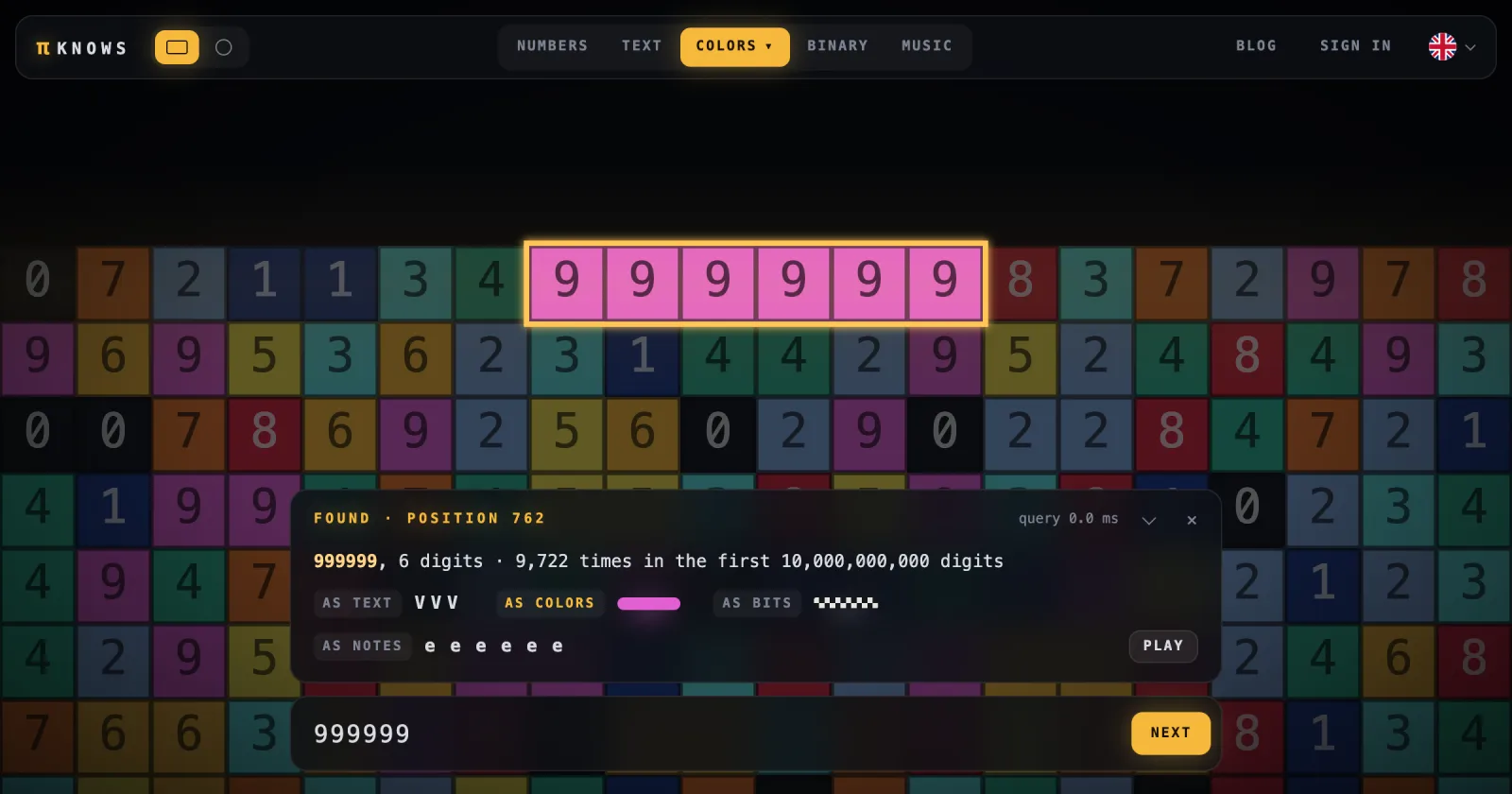
The first digits of pi, one color per digit. Six nines in a row start at position 762, a spot known as the Feynman point.
What is proven about pi
Pi never ends and never repeats. Johann Heinrich Lambert proved that it is irrational in the 1760s, and Ferdinand von Lindemann proved in 1882 that it is transcendental: it is not the root of any polynomial with whole number coefficients.
Neither fact puts every number in pi. The number 0.101001000100001… never ends and never repeats either, yet it never contains a single 2.
What would make it true: normal numbers
Mathematicians call a number normal when every string of digits appears as often as chance predicts: each digit once in every 10, each pair once in every 100, and so on. A normal number contains every finite string of digits, infinitely many times.
Émile Borel showed in 1909 that almost every real number is normal. For pi, as for √2 and e, nobody has a proof.
What the first 10 billion digits of pi show
The first 10,000,000,000 digits look the way a normal number should. Each digit makes up 10% of them, to within 0.0007%. Chance alone typically moves a count about 30,000 away from one billion. The largest gap, for the digit 4, is 62,312, about twice that, which is ordinary among ten digits:
How far each digit's count is from exactly one billionA tenth of 10,000,000,000 is 1,000,000,000. The band is 30,000 either side: how far chance alone typically moves a count.
In piTypical chance wobble
Digit
Count
Share
0
999,967,995
9.99968%
1
1,000,037,790
10.00038%
2
1,000,017,271
10.00017%
3
999,976,483
9.99976%
4
999,937,688
9.99938%
5
1,000,007,928
10.00008%
6
999,985,731
9.99986%
7
1,000,041,330
10.00041%
8
999,991,772
9.99992%
9
1,000,036,012
10.00036%
Longer strings tell the same story. Every 8 digit string appears, between 50 and 165 times, and the spread of those counts sits right on the curve chance predicts:
How often each 8 digit string appearsAll 100,000,000 strings from 00000000 to 99999999, counted in the first 10 billion digits of pi, two counts to a bar.
In piChance predicts
Runs of a single digit fit chance as well. The first 10 billion digits hold eight runs of ten identical digits and none of eleven, close to the eight chance predicts. The earliest long run, six 9s at position 762, is known as the Feynman point.
Long strings need many digits
A string of n digits turns up on average once in every 10n digits. In the first 10 billion digits, all 500 random 9 digit strings we tried appear, 629 of 1,000 random 10 digit strings do, close to the 63% chance predicts, and only about 1% of 12 digit strings:
Share of random numbers found in pi, by lengthSearched in the first 10 billion digits. 8 digits: every one of the 100,000,000. 9 to 12 digits: 500, 1,000, 1,000 and 2,000 random numbers.
In piChance predicts
That is why 0123456789 is not in the first 10 billion digits. It does appear at position 17,387,594,880. A 12 digit string needs around a trillion digits, and a 20 digit string about a hundred billion billion.
So is your name in pi?
If pi is normal, then yes, and so is everything that can be written with digits. Words are easy to try: reading each pair of digits as a letter, hello first appears at position 310,131, and 993 times in the first 10 billion digits. A word found by chance is not a message, though: see is there a message in pi. Dates are certain to be there: see is your birthday in pi.
Frequently asked questions
Does pi contain every number?
Nobody knows. It would if pi is a normal number, which most mathematicians believe but nobody has proved. In the first 10 billion digits, every 8 digit string appears at least 50 times.
Is pi a normal number?
It is not proven. Its first 10 billion digits look normal: each digit makes up 10% of them to within 0.0007%, and every 8 digit string appears about as often as chance predicts.
Is it enough that pi never ends and never repeats?
No. The number 0.101001000100001… never ends and never repeats, yet it contains no 2 at all. Containing every number needs more than being irrational.
Where does 0123456789 appear in pi?
Not in the first 10 billion digits. It appears at position 17,387,594,880.